|
Presented by Agraya | A swerve on Food for Peace from US congressional Republicans.
|
|

|

|
|
||||
|
They say every crisis is an opportunity. If a group of farmers and food systems leaders has its way, the Middle East conflict will be the push governments need to finally reform public spending on agriculture so that it’s much more aligned with global climate goals.
On Monday I was in Ankara, Turkey, for the launch of the High-Level Panel for a Just Rural Transition — a lofty name for a coalition with lofty ambitions to help redirect the $700 billion spent annually on farm subsidies away from fossil fuel-intensive chemical fertilizers, pesticides, and other environmentally destructive practices along the path from farm to fork. The initiative was convened by Clim-Eat, a Netherlands-based “think-and-do” tank, as part of the U.K.-funded Voices for Just Rural Transitions program. And the hope is that Turkey, which is hosting the United Nations’ COP31 climate conference this year, will incorporate the initiative into its official agenda. 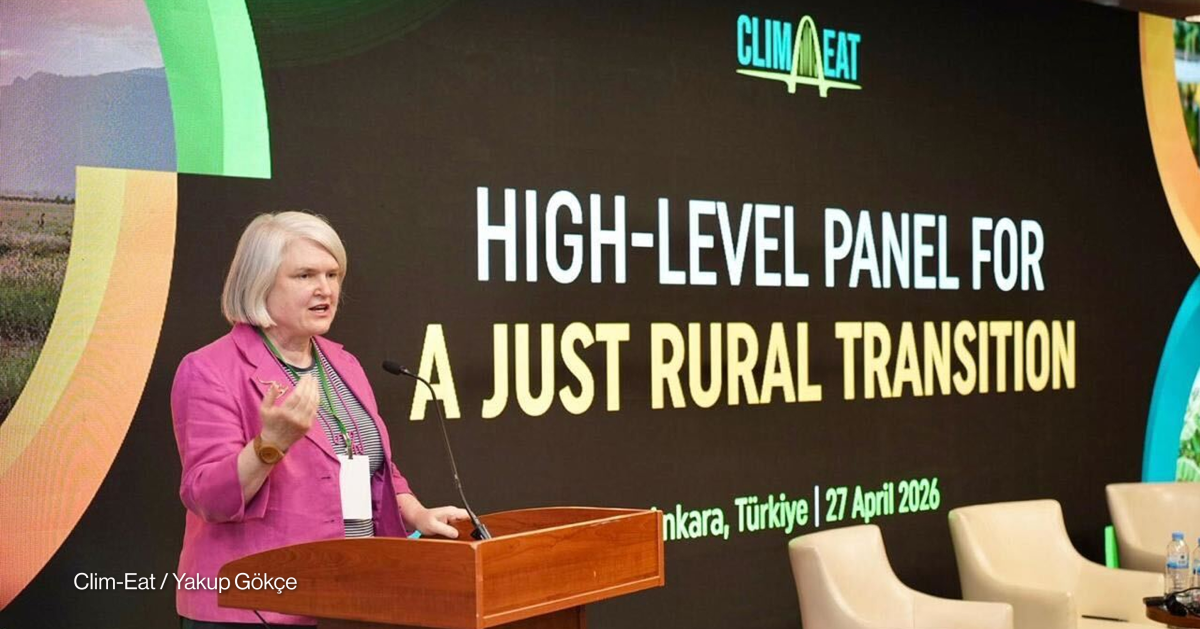 “So many countries are hooked into this trap of subsidy, subsidy, subsidy,” Dhanush Dinesh, the founder of Clim-Eat, told me. But studies show that farmers see only 35 cents of real value for every dollar spent. The panel members believe that repurposing public support for farmers — not just subsidies, but also things such as extension services to train them on improving yields and livelihoods — is a major untapped resource to reduce greenhouse gas emissions, protect biodiversity, prevent land degradation, and make agrifood systems more sustainable. The 12-member panel is chaired by former Costa Rican President Carlos Alvarado Quesada, who knows a thing or two about lofty goals: In 2019 he launched a national plan to reach net-zero carbon emissions by 2050 that many critics once thought impossible. Also among the group is Andrea Meza Murillo, deputy executive secretary of the United Nations Convention to Combat Desertification, or UNCCD; Gabriel Ferrero, strategic adviser to the World Bank-hosted Global Agriculture and and Food Security Program, or GAFSP; Alice Ruhweza, president of AGRA; Martien van Nieuwkoop, director of agricultural development at the Gates Foundation; and Gertrude Kambauwa, director of the department of land resources conservation in the Malawian Ministry of Agriculture. Why are we spending such a mind-boggling amount on subsidies? “The answer to that is what we call the political economy. It’s politics,” said panel member Sonja Vermeulen, an expert on sustainable agriculture, at Monday’s launch. Policymakers who want to stay in office can only think as far as the next election. They face powerful constituencies that benefit from the status quo and are resistant to change. That’s why governments end up maintaining and investing in agrifood policies that are misaligned with long-term climate and development goals. A major United Nations report in 2021 found that 87% of agricultural subsidies harm people and the planet while distorting food prices. One example of this misalignment can be found in Nigeria, which is investing in value chains for maize in order to help develop its poorer northern region — even though “they know in ten years’ time, maize will not be a viable crop,” Vermeulen said. Likewise, the European Union devotes about a third of its entire budget to agricultural subsidies, and of that around 80% goes toward livestock farming — despite its major carbon footprint. On the flip side is Malawi, which has totally redesigned its support so that farmers are now paid to improve soil health. The work of the panel, Vermeulen added, is to understand policymakers’ resistance to change — and give them some tools to break through the deadlock. And farmers’ own voices must be at the center. Climate advocacy groups and development banks have been calling for farm subsidy reform for more than a decade. Now an opportunity has arisen with the Iran conflict, which has sent the price of fertilizer and other farm inputs skyrocketing. Much of the world’s fertilizer is made in the Middle East, and one-third of it passes through the Strait of Hormuz, which has been mostly closed to trade since the conflict began. Countries seeking to salvage this planting season and avoid food crises now face diverging paths: They could roll out import bans and tariffs, while offering more fertilizer subsidies to balance the higher prices. Or they could move toward more climate-resilient agriculture — a feat much easier said than done. In the short term, it is not politically feasible to simply stop supporting farmers, who are worried about the costs of fuel and fertilizer, GAFSP’s Ferrero said during a discussion that I moderated. Rather, “it could work by saying, ‘we need to support you now, temporarily,’ clearly, publicly — but what we need now is to accelerate [the transition to sustainable agrifood systems], because you are feeling how vulnerable you are,” he said. On the African continent, the path forward must include localizing seed systems — currently, much of farmers’ inputs are imported — and pursuing a “comprehensive soil health approach, not relying on synthetic fertilizer,” in order to reduce vulnerability to global shocks, panel member Tshilidzi Madzivhandila, CEO of the Food, Agriculture and Natural Resources Policy Analysis Network, or FANRPAN, said during the discussion. The panel aims to launch its final report for policymakers at COP31 in November. Turkey — which has emphasized the links among food, water, and energy in its COP31 action agenda — has shown strong interest in the initiative. It nominated Orhan Solak, deputy director of the country’s directorate of climate change, to the panel, and numerous of its agriculture, labor, and climate officials went to Monday's launch event. Yesterday, Quesada met with COP31 President-Designate Murat Kurum in Ankara to seek official collaboration. Does this moment contain all the magic ingredients to finally reform farm subsidies? At the very least, it’s a fertile opportunity. Background reading: Agricultural subsidy reform is needed to meet SDGs, UN report says Read and watch: Iran war severely disrupts fertilizer shipments, but effects are complex 
|
|
A message from Agraya
Agraya Changemaker Awards: Advancing women farmers Does your work support women farmers and create better opportunities across the value chain? Apply for the Changemaker Awards 2026! Taking applications across innovation, sustainability, and community impact until May 15. Winners will be announced at the Agraya Summit 2026 in Italy. Apply now for your chance to be recognized! |
|
Weapon of Mast destruction
Speaking of upheaval, the United States’ flagship food aid program, Food for Peace, has gone through some massive changes in the past year — its activities crippled as the program shifted from a shuttered USAID to the State Department and then the Department of Agriculture. Now the authority for Food for Peace may shift again, this time to President Donald Trump — yes, the very same president who tried to cut all of its funding twice.
That potential change is spelled out in an amendment buried deep in the Food, Farm and National Security Act of 2026, better known as the Farm Bill, the sweeping $1.37 trillion legislation that governs U.S. agricultural policy. Specifically, the amendment would “[repeal] the transfer of Food for Peace from USAID to USDA and moves the authority for the administration of Food for Peace to the President,” reports my colleague Elissa Miolene. The bill cleared a key congressional hurdle last night — the House Rules Committee — and goes to the full House floor for a debate today. The amendment was brought by Rep. Brian Mast, a Republican from Florida. His office did not reply to Elissa’s request for comment, so it’s unclear whether the move was meant to kill Food for Peace or restructure it. “We’re pretty confused by this amendment,” says a Democratic aide, speaking to Devex on the condition of anonymity. “This is a president who has now zeroed out Food for Peace in the last two of his budget requests, which I think shows certainly that he doesn’t prioritize Food for Peace and doesn’t want to be doing this program.” Read more: Food for Peace faces shake-up as Farm Bill clears key committee See also: USDA takes over Food for Peace with $452M World Food Programme deal Background: After USAID, Food for Peace enters a new and uncertain chapter
|
|
Sponsored by The Nature Conservancy
|
|
Dire data
|
|
“Humanitarians are forced to make impossible choices: Who eats and who doesn’t, who lives and who doesn’t? Funding humanitarian response is not a charity alone. It’s the smartest investment any country can make.”
—
Cindy McCain, executive director, World Food Programme
|
|
The findings of the latest Global Report on Food Crises are stark. The world’s hunger crises are becoming more protracted and more severe, and they’re increasingly concentrated in a small group of countries — but funding for humanitarian and development aid has fallen to levels last seen a decade ago. Here are the numbers that have stuck with me.
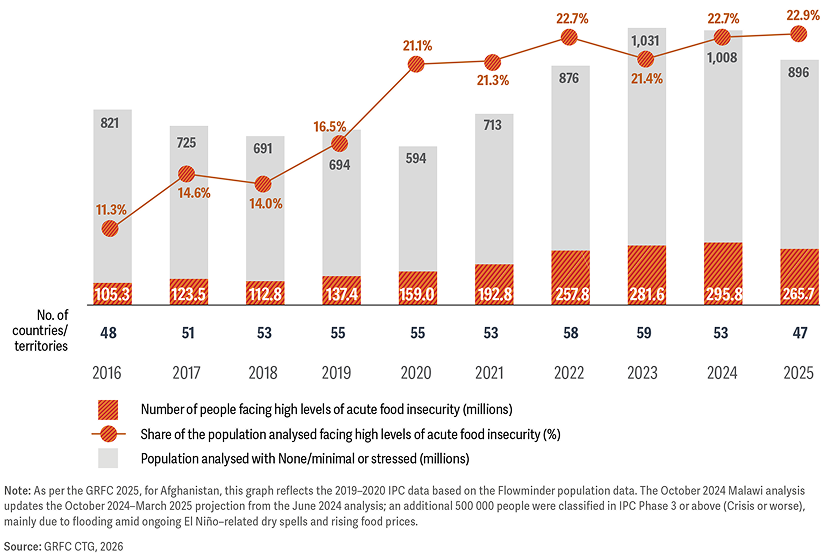
The report also explored another worrying trend: Access restrictions and funding shortfalls mean that much less data on hunger is being collected compared to past years. Although 65 countries were selected for inclusion in this year’s report because they required food assistance or faced shocks, 18 of them had no data or could not provide data that met the report’s standards. These data gaps will hamper future efforts to address food insecurity, experts warned at the report’s launch on Friday in London. Read: Global hunger is becoming more concentrated and more severe, UN says Background: Why are there so many different measures of food insecurity? See also: US threatens to halt UN funding unless conditions met |
|
A message from Agraya
Agraya Changemaker Awards 2026: Making change visible
Real change is happening through initiatives that uplift women farmers and shape fairer, more inclusive food systems. The Changemaker Awards recognize this progress as part of the U.N. International Year of the Woman Farmer. Winners will be honored at the Agraya Summit 2026 in Bologna. All finalists receive a free two-day pass; winners also get a hotel stay, dinner invitation, and can apply for travel support. Apply by May 15. |
|
|
|
Chew on this
High-level talks now underway in Santa Marta, Colombia, are highlighting the lack of financing for the shift away from fossil fuels. [The Washington Post] The world’s food systems have been “pushed to the brink” by extreme heat, leaving farmers unable to work outside and also killing off livestock, according to a study by FAO and the World Meteorological Organization. [The Guardian] After more than two years of war with Israel, only 4% of Gaza’s cropland is both accessible and undamaged, illustrating the near-total collapse of local food production. [Mercy Corps] The World Bank has teamed up with Amazon.com on a bond whose proceeds will go toward rehabilitating South Africa’s Eastern Cape Province — specifically the Spekbook, or “bacon tree,” which sequesters carbon and helps soil retain water. [Bloomberg] Can African food systems thrive without chemical fertilizers? The nonprofit GRAIN explores how the continent is faring amid the Iran war. [GRAIN] 
|
|
Thank you for reading this week’s Devex Dish, edited by Fiona Zublin, copy edited by Florence Williams, and produced by Adia Pauline Lim. Have a news tip? Email [email protected].
Forwarded by a friend?
Sign up here to receive the Devex Dish directly.
|
|
Devex thanks our partners for supporting our newsletters.
Our editorial content remains independent. Interested in partnering with us? Get in touch.
Would you recommend our content?


|
|
Connect with us:
|


